
Intuitive Screenplay Formatting
Write Clearly Without Breaking Your Creative Flow
Learn the system behind professional screenplay formatting—so you can make confident decisions, handle the tricky cases, and keep writing without breaking your creative flow.
Stop interrupting your draft to search for answers about phone calls, montages, action lines, transitions, or other formatting details.
Whether you’re writing for readers, collaborators, producers, cast, or your own future production, the page should make the movie easier to experience.
I'M READYIS THIS YOU?
When Formatting Interrupts Your Story
I totally get it. You may know the basics—scene headings, character names in caps, Courier font—but the in-between decisions can still stop a draft cold.
😶🌫️ I can see the scene in my head, but I’m not sure how to stage it clearly on the page.
😩 I keep stopping to look up how to format phone calls, montages, time jumps, or transitions.
😅 My action lines are technically correct, but the page still feels dense or difficult to read...
😵💫 I’m unsure when a formatting choice supports the story—and when it becomes unnecessary noise.
🤩 I want my screenplay to feel professional before I share it with readers, collaborators, producers, cast, or crew.

Formatting Is Part of the Read
Formatting is not just a set of rules. It is part of how the reader experiences the movie you’re putting on the page.
When the page is confusing, inconsistent, or overloaded, the reader starts seeing the formatting instead of feeling the story.
Once the essentials become intuitive, formatting can clarify the action, shape the rhythm, and guide the reader through the scene.
IMAGINE IF YOU COULD...
Write Without Breaking Your Flow
Learn the essentials once. Know where to look when a tricky case appears to keep the scene moving.
The goal is not to memorize every formatting rule before you write. It is to understand the underlying system well enough that the common decisions become intuitive—and to have a reliable reference when an unusual one appears.
That is how formatting becomes a support for the writing instead of an interruption.
I WANT TO WRITE EFFORTLESSLYHOW IT WORKS
Formatting Is a Framework, Not a Formula
You don’t need to memorize every rule before you can write.
Instead, you need to understand what the major formatting elements are doing for the reader—and know how to make a clear choice when a scene presents an unusual problem.
That's exactly what Intuitive Screenplay Formatting teaches:
- The conventions that make a screenplay easy to read.
- The choices that help action, dialogue, and white space support the scene.
- The cases that interrupts drafts.
Once those decisions become familiar, you can spend less time searching for formatting answers and more time shaping the movie on the page.

THIS IS
Intuitive Screenplay Formatting
A practical course and quick-reference system for clear, confident screenplay pages.
Make Confident Formatting Decisions While You Write
Intuitive Screenplay Formatting will help you:
- Understand when, why, and how to use the major formatting elements.
- Handle unusual cases without losing an hour to conflicting search results.
- Shape action lines, white space, and scene description for a clearer visual read.
- Prepare pages that are easier for readers and collaborators to follow.
- Keep writing momentum when the screenplay requires a specific formatting choice.
- Use the page as a clearer blueprint for the movie you’re building.
In the Course:
MODULE 1
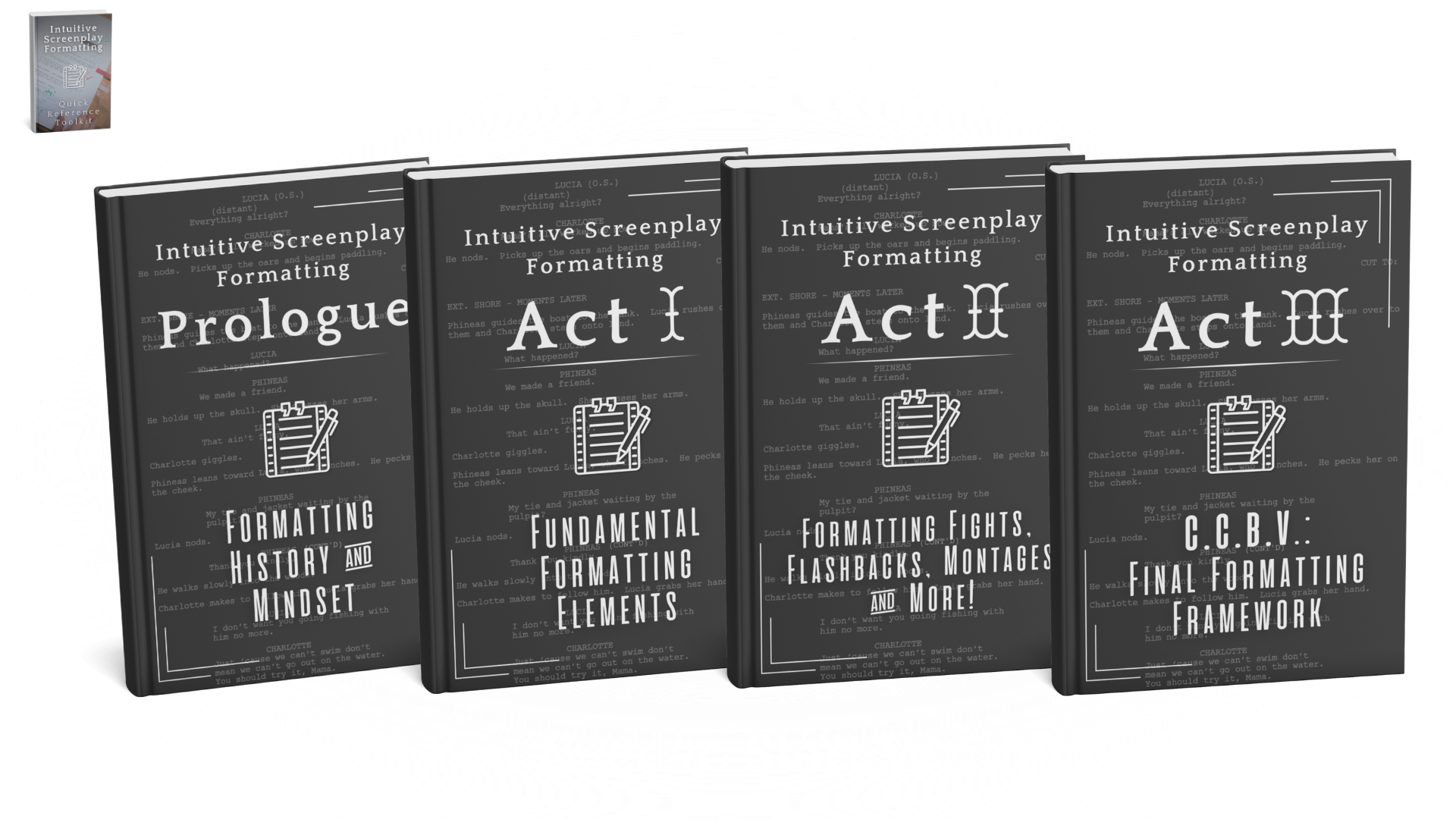
Build the Formatting Framework
Understand where screenplay formatting came from, why scripts can look different from one another, and how the major elements work together as a practical visual system.
Outcomes:
-
Understand what formatting is doing for the reader.
-
Choose and use screenwriting software with less uncertainty.
-
Replace “formatting phobia” with a workable mental model.
-
Distinguish essential conventions from rigid rules that do not serve the scene.
MODULE 2
Make the Page Clear and Visual
Learn the core page elements that help a reader understand what is happening, what matters, and how the scene moves.
Outcomes:
-
Write clearer slug lines.
-
Introduce characters efficiently.
-
Shape action lines and white space for readability and emphasis.
-
Use O.S., V.O., and wrylies intentionally.
-
Keep description visual without turning the screenplay into prose.
MODULE 3
Handle the Cases That Usually Stop the Draft
Understand how to make formatting decisions when the scene includes time shifts, multiple locations, action sequences, or unusual transitions.
Outcomes:
-
Format supers, subheadings, and INT./EXT. correctly.
-
Choose between flashback, montage, and other structural devices.
-
Handle ellipses and dashes without guessing.
-
Format action-heavy scenes clearly.
-
Know when a transition helps and when it merely adds clutter.
MODULE 4
Use the Page as a Cinematic Tool
Move beyond compliance and learn how formatting choices can support visual storytelling, pacing, and the reader’s experience.
Outcomes:
-
Apply practical guidelines when a scene does not fit a simple template.
-
Recognize when a formatting “rule” should be adapted to serve the scene.
-
Use the bonus visual-storytelling techniques to guide attention on the page.
-
Connect formatting choices to the cinematic experience you want the reader to have.
Learn by Applying the Decisions
Throughout the course, you’ll have:
- Short quizzes to reinforce the distinctions that are easy to confuse.
- Practical exercises using real screenplay situations.
- Examples that show not only what to do, but why the choice works.
- A place to ask questions and clarify difficult cases.
DIRECTOR + SCREENWRITER
I'm Carl T. Rogers
Learn from a Writer-Director.
I’m Carl T. Rogers, a writer-director with an M.F.A. in Directing. I’ve written and directed award-winning shorts, spent years tutoring screenwriters, and learned firsthand that formatting becomes more useful once you understand what it is doing for the reader and the scene.
This course distills that perspective into a practical system for writing clear screenplay pages, handling the tricky cases, and staying connected to the movie you’re building.


CARL HAS COLLABORATED WITH OR BEEN FEATURED BY:


This Course Is For You If...
-
You know the basics but still stop writing when a tricky formatting question appears.
-
You want a screenplay that reads clearly and professionally before you share it.
-
You are writing a short, feature, or other screenplay and want a reliable formatting reference.
-
You want to use action lines, white space, and scene description more intentionally.
-
You are preparing pages for readers, collaborators, producers, cast, crew, or your own future production.
-
You are interested in deeper visual screenwriting but want to strengthen the page-level fundamentals first.
Do I need screenwriting software?
Do I need to buy formatting books?
What if I already know the basics?
What if English isn't my first language?
Is this course only for writer-directors?
Does this course make my screenplay production-ready?
Stop Letting Formatting Interrupt the Draft
Learn the system behind professional screenplay formatting, handle the tricky cases with more confidence, and keep your attention on the movie you’re building!
Start Writing Without Breaking Your Flow